
Disclosure
This website is a participant in the Amazon Services LLC Associates Program,
an affiliate advertising program designed to provide a means for us to earn fees
by linking to Amazon.com and affiliated sites.
Is your 9V battery actually dead? A simple voltage check tells the real story. Our complete 9V battery voltage chart gives you the definitive answer.
Knowing the exact voltage prevents you from throwing away perfectly good batteries. This guide solves the common frustration of guessing your battery’s remaining life.
Best Multimeters for Testing 9V Battery Voltage
Klein Tools MM325 Multimeter – Best Overall Choice
This multimeter offers reliable auto-ranging and clear voltage readings down to 0.1V increments, perfect for checking 9V batteries. Its durable build and simple two-button operation make it ideal for both beginners and professionals needing quick, accurate diagnostics.

- VERSATILE FUNCTIONALITY: Measures AC/DC voltage up to 600V, 10A DC current…
- LEAD-ALERT PROTECTION: LEDs on the meter illuminate to indicate proper test…
- BACKLIT DISPLAY: LCD shows clear readings in low-light conditions for…
Fluke 101 Basic Digital Multimeter – Best for Home Use
The Fluke 101 is a trusted, easy-to-use multimeter designed for basic household tasks like testing batteries. It provides accurate DC voltage measurements and is compact for storage in a toolbox. This model is the recommended option for occasional, reliable use.

- Basic dc accuracy 0.5%
- CAT III 600 V safety rated
- Diode and continuity test with buzzer
AstroAI Digital Multimeter AM33D – Best Budget Option
For a cost-effective tool, the AstroAI AM33D delivers essential functions including a dedicated battery test mode for 9V and 1.5V batteries. It features a clear display and comes with test leads, making it the ideal for DIYers and homeowners on a budget.

- Additional Tips – The following incorrect operations may cause the…
- Versatile Digital Multimeter – Accurately measures AC/DC Voltage, DC…
- Troubleshooting with Accuracy – This Multimeter has a sampling speed of…
9V Battery Voltage Levels and Health
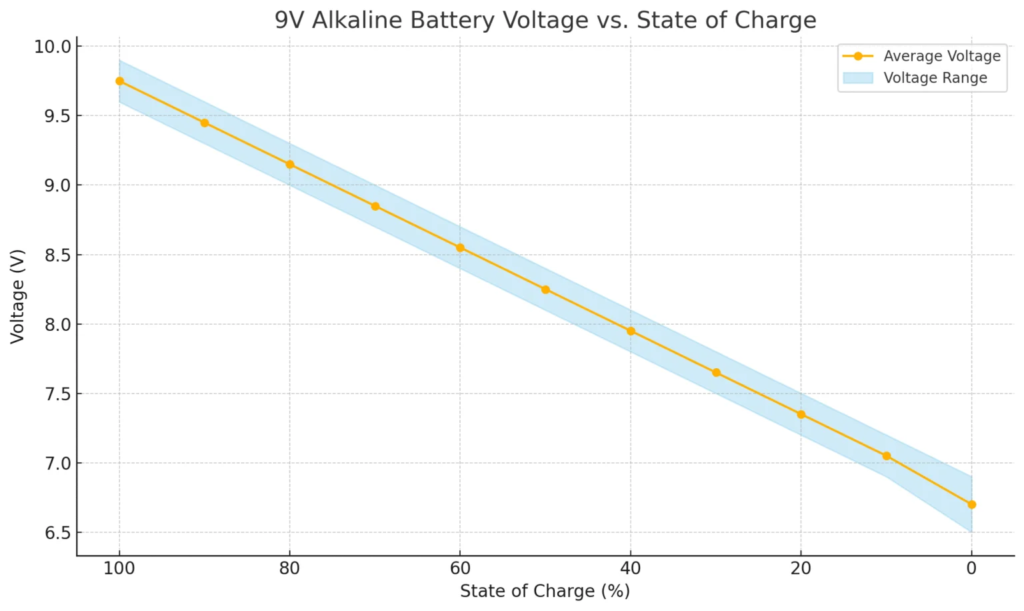
A 9V battery’s voltage is the best indicator of its remaining power and health. Fresh batteries do not start at exactly 9 volts. The actual voltage varies significantly by chemistry and declines with use.
| State of Charge (%) | Voltage (V) |
|---|---|
| 100% | 9.6 – 9.9 |
| 90% | 9.3 – 9.6 |
| 80% | 9.0 – 9.3 |
| 70% | 8.7 – 9.0 |
| 60% | 8.4 – 8.7 |
| 50% | 8.1 – 8.4 |
| 40% | 7.8 – 8.1 |
| 30% | 7.5 – 7.8 |
| 20% | 7.2 – 7.5 |
| 10% | 6.9 – 7.2 |
| 0% (empty) | Below 6.9 |
Fresh vs. Nominal Voltage: What to Expect
The “9V” label is a nominal rating, not the actual measured voltage. A brand new battery will always test higher. This initial surplus is your performance buffer.
- Alkaline: A new alkaline 9V typically reads about 9.5 to 9.6 volts.
- Lithium: A new lithium 9V starts even higher, often at 9.6 to 9.8 volts.
- Rechargeable (NiMH): These have a lower nominal voltage, starting around 8.4 to 9.0 volts when fully charged.
Key Takeaway: A reading above 9V is normal for a fresh disposable battery. Do not be alarmed if your new battery shows 9.5V or more.
Interpreting the 9V Battery Voltage Chart
Use the chart below as your quick-reference guide. It shows the critical voltage thresholds for common 9V battery types.
| Battery Type | Fresh/Full Charge | Good/Usable | Weak/Replace Soon | Dead/Replace |
|---|---|---|---|---|
| Alkaline | 9.5V – 9.6V | 9.0V – 9.4V | 8.5V – 8.9V | < 8.4V |
| Lithium | 9.6V – 9.8V | 9.0V – 9.5V | 8.7V – 8.9V | < 8.6V |
| NiMH Rechargeable | 8.4V – 9.0V | 7.8V – 8.3V | 7.2V – 7.7V | < 7.2V |
A battery is considered “dead” for most devices when it drops below 8.4V for alkalines. However, some sensitive electronics like smoke detectors may fail at higher voltages. Always check your device manual.
How to Test a 9V Battery Voltage Accurately
Testing your battery’s voltage is a simple, 30-second process. You only need a digital multimeter and the battery itself. This method is far more reliable than the “tongue test” or guessing.
Follow this step-by-step guide for precise results. Accurate testing prevents you from discarding batteries that still have life.
Step-by-Step Guide to Using a Multimeter
Using a multimeter correctly ensures you get a true reading of your battery’s health. Set up your tool properly before testing.
- Set the Multimeter: Turn the dial to DC Voltage (V with a straight line). Choose a range above 10V, or use auto-ranging mode if available.
- Connect the Probes: Touch the red probe to the positive (+) terminal and the black probe to the negative (-) terminal of the 9V battery.
- Read the Display: Hold the connections steady for a few seconds. Record the stable voltage number shown on the digital display.
Pro Tip: For the most accurate reading, test the battery under a small load. You can do this by testing it while it’s connected to the device, if possible.
Common Testing Mistakes to Avoid
Small errors can lead to incorrect voltage readings. Avoid these common pitfalls for trustworthy results.
- Testing Under No Load: A battery can show a decent voltage with no load but drop significantly when powering a device. This is called “surface charge.”
- Incorrect Polarity: Reversing the probes (red to negative) will give a negative voltage reading. This won’t damage the meter but can confuse your reading.
- Using a Low-Quality Meter: Very cheap multimeters may lack precision. They can give inconsistent readings, making it hard to trust the results.
Once you have an accurate voltage, compare it to the voltage chart in the previous section. This tells you the true state of your battery’s charge.
9V Battery Types and Their Voltage Characteristics
Not all 9V batteries are created equal. Different chemistries have unique voltage profiles and performance traits. Understanding these differences is key to choosing the right battery.
This section breaks down the three main types: alkaline, lithium, and rechargeable. You’ll learn which type is best for your specific needs and devices.
Alkaline vs. Lithium 9V Batteries
Alkaline and lithium are the most common disposable 9V batteries. Their voltage behavior and longevity differ significantly.
- Alkaline Batteries: These are the standard, cost-effective choice. They have a gradual voltage decline over their lifespan. Ideal for low-drain devices like clocks and remote controls.
- Lithium Batteries: These provide a higher starting voltage and maintain it longer. They perform exceptionally well in extreme temperatures and high-drain devices. Perfect for professional smoke detectors and outdoor gear.
| Feature | Alkaline 9V | Lithium 9V |
|---|---|---|
| Best For | Low-drain, everyday devices | High-drain, critical, or extreme environments |
| Voltage Curve | Steady, gradual decline | Long plateau, then sharp drop |
| Cost | Lower upfront cost | Higher upfront, better long-term value |
| Weight | Heavier | Lighter |
Rechargeable 9V Battery Voltage
Rechargeable 9V batteries, typically Nickel-Metal Hydride (NiMH), operate at a lower nominal voltage. This is normal and does not indicate poor performance.
A fully charged NiMH 9V battery starts around 8.4V to 9.0V. It will spend most of its usable life between 7.2V and 8.4V. Do not compare its voltage directly to an alkaline chart.
Critical Note: Many modern devices are designed to work with the lower voltage of NiMH batteries. Always check if your device is compatible with rechargeables before use.
The key advantage is the flat discharge curve. A NiMH battery delivers consistent power until it is nearly depleted, then the voltage drops quickly.
Practical Applications and When to Replace Your 9V Battery
Knowing the voltage is only half the battle. The real value comes from applying that knowledge to your devices. Different equipment has different power tolerances.
This section translates voltage readings into actionable advice. Learn the specific thresholds for common household and professional devices.
Critical Devices: Smoke Detectors and Carbon Monoxide Alarms
These are life-saving devices where battery performance is non-negotiable. They often require a higher minimum voltage than other electronics to function reliably.
- Replace Immediately: Most alarms will start chirping at around 8.2 to 8.4 volts. Do not wait for the low-battery warning to test.
- Proactive Testing: Check your alarm’s battery voltage every 3-6 months. If it reads below 9.0V for an alkaline battery, consider replacing it for optimal safety.
- Best Practice: For these critical applications, lithium 9V batteries are highly recommended due to their longer lifespan and stable voltage output.
Safety First: Never use a “weak” battery in a smoke detector. A voltage reading that is “good enough” for a toy is not sufficient for a life-safety device.
Everyday Electronics: Toys, Radios, and Guitar Pedals
For non-critical electronics, you can often use a battery until it is fully depleted. Performance will simply degrade as the voltage drops.
Use the general voltage chart as your guide. However, be aware of device-specific symptoms.
- Toys & Radios: These may work down to 7.5V but with dim lights or slow motor speed. Replace when performance becomes unsatisfactory.
- Guitar Pedals & Pro Audio: These devices are sensitive to voltage sag. A drop below 8.5V can cause unwanted noise, signal loss, or tonal changes.
- General Rule: For consistent performance in everyday items, replace alkaline batteries when they drop below 8.5 volts.
Advanced Tips for Maximizing 9V Battery Life and Performance
Beyond simple voltage testing, you can extend your battery’s useful life significantly. Proper storage, handling, and understanding real-world performance are key.
Implement these expert strategies to get the most value from every 9V battery. This saves money and reduces environmental waste.
Optimal Storage Conditions for 9V Batteries
How you store unused batteries directly impacts their shelf life and future performance. Avoid common mistakes that lead to premature discharge.
- Temperature Control: Store batteries in a cool, dry place at room temperature. Avoid garages or cars where extreme heat or cold accelerates chemical degradation.
- Prevent Short Circuits: Never store loose 9V batteries where their terminals can touch metal objects or each other. This can cause a dangerous short circuit and rapid discharge.
- Original Packaging: Keep batteries in their original packaging until use. This protects the terminals and prevents accidental discharge.
Storage Fact: A quality alkaline 9V battery can retain 80-90% of its charge for up to 5 years when stored properly at 20°C (68°F).
Load and Real-World Voltage Sag
A multimeter reading shows open-circuit voltage. The true test is how the battery performs under the load of your device. This is called voltage sag.
A battery may read 9.2V with no load but drop to 8.0V when powering a high-drain device. This explains why a battery can “test good” but fail in use.
When to Recycle vs. When to Reuse
Not all “dead” batteries are equal. Some may still have useful life in less demanding applications.
- Recycle: Immediately recycle any battery that tests below the “dead” threshold (e.g., <8.4V for alkaline), shows physical damage, or leaks.
- Reuse (Temporarily): A battery reading 8.5V-8.9V may still power a very low-drain device like a wall clock for a short time. This is a temporary solution, not a recommendation for critical devices.
- Best Practice: Use a battery sorter to organize partially used batteries by voltage. Label them clearly to avoid mixing them with fresh ones.
Applying these advanced tips ensures you are not just measuring voltage, but truly managing your battery resources effectively.
Troubleshooting Common 9V Battery Voltage Issues
Sometimes voltage readings can be confusing or seem contradictory. This section solves common problems users encounter when testing their 9V batteries.
Learn to diagnose these issues correctly. This prevents you from making the wrong decision about your battery’s health.
Why a “Good” Voltage Reading Doesn’t Always Mean a Good Battery
You may measure a voltage above 9V, but the battery still fails to power your device. This frustrating scenario has a few likely causes.
- High Internal Resistance: This is the most common culprit. An old or depleted battery develops high internal resistance. It shows voltage with no load but cannot deliver sufficient current under demand.
- Surface Charge: A recently used or charged battery can hold a temporary surface charge. This gives a falsely high reading that drops quickly under load. Let the battery rest for an hour before a final test.
- Faulty Connection: Corroded terminals on the battery or in the device create resistance. Clean the contacts with isopropyl alcohol and a cotton swab before retesting.
Diagnostic Test: To check for high internal resistance, test the voltage while the battery is under load (e.g., connected to the device). A large voltage drop confirms the issue.
Decoding Inconsistent or Fluctuating Readings
If your multimeter display is unstable, don’t assume the battery is bad immediately. The problem might be with your testing method.
- Check Probe Contact: Ensure the metal probes are making firm, clean contact with the battery terminals. Wiggling or poor contact causes the reading to jump.
- Test Battery Temperature: A very cold battery will show lower voltage and poor performance. Let it warm to room temperature and test again.
- Verify Multimeter Health: Low batteries in your multimeter itself can cause inaccurate readings. Replace them and retest the 9V battery.
What to Do With Batteries in the “Weak” Voltage Range
Batteries reading between 8.5V and 8.9V (for alkaline) are in a gray zone. They are not dead but are nearing the end of their useful life.
Designate these for low-priority, non-critical devices. Use them in a portable radio, a simple LED light, or a child’s toy where gradual performance loss is acceptable. Never install them in a smoke detector.
Conclusion: Mastering Your 9V Battery Voltage for Smarter Power Management
Understanding the 9V battery voltage chart transforms guesswork into precise knowledge. You can now accurately diagnose battery health and extend device performance. This saves money and prevents frustration.
The key takeaway is simple: test, don’t guess. Use a multimeter and our voltage charts to make informed decisions. This is especially critical for safety devices like smoke detectors.
Start by testing all your 9V batteries today. Organize them by voltage level for optimal use. Invest in a reliable multimeter if you haven’t already.
With this knowledge, you are in complete control of your battery power and device reliability.
Frequently Asked Questions About 9V Battery Voltage
What is the minimum voltage for a 9V battery to still work?
The minimum working voltage depends on the device. Most electronics will stop functioning when the battery drops below 7.5 to 8.0 volts. However, for reliable performance, you should replace an alkaline battery once it falls below 8.4V.
Critical devices like smoke detectors require a higher minimum voltage, often around 8.2V-8.4V, to ensure their alarm can sound at full power. Always prioritize safety over squeezing out the last bit of charge.
How to test a 9V battery without a multimeter?
Without a multimeter, you can perform a crude load test. Connect the battery to a small 9V bulb or a low-power motor. Observe the brightness or speed; a dim light or slow motor indicates a weak battery.
For a simple check, some people use the “tongue test” (a slight tingle means charge), but this is unreliable and not recommended. Investing in an inexpensive multimeter provides accurate, safe results.
What voltage is a dead 9V battery?
A standard alkaline 9V battery is considered dead for practical purposes when its voltage reads below 8.4 volts under no load. At this point, it will likely fail to power most devices effectively.
It’s important to note that a “dead” battery still holds some residual charge. It should be properly recycled, not thrown in the regular trash, to prevent environmental contamination.
Why does my 9V battery die so quickly?
Rapid battery drain is often caused by a high-drain device or a parasitic drain. Devices like powerful guitar pedals or wireless microphones consume power quickly. Also, check if the device is fully turning off.
Old age, improper storage in hot conditions, or using the wrong battery type (e.g., alkaline in a high-drain application meant for lithium) can also drastically shorten battery life.
Are all 9V batteries the same size and voltage?
Yes, all standard 9V batteries have identical physical dimensions and connector snaps (the positive and negative posts). This ensures they fit universally in devices designed for a 9V battery.
Their nominal voltage is the same (9V), but their fresh voltage and chemistry differ. Alkaline, lithium, and rechargeable NiMH all start at different voltages and have unique discharge curves, as shown in the voltage chart.
What is the best way to store 9V batteries long-term?
The best way is to store them in their original packaging in a cool, dry place at room temperature. Avoid locations with temperature extremes, like a car glovebox or a damp basement.
To prevent accidental short circuits and fires, place a piece of tape over the terminals if storing loose batteries. Never store them in a metal container or where terminals can touch.
Can I use a rechargeable 9V battery in any device?
Not always. While physically compatible, rechargeable NiMH batteries have a lower nominal voltage (7.2V-8.4V). Some voltage-sensitive devices, like certain smoke detectors or vintage electronics, may not work correctly.
Always check your device manual for compatibility with rechargeable batteries. For devices that are used frequently, rechargeables are an excellent, cost-effective, and eco-friendly choice.
How accurate is the battery test function on a multimeter?
The dedicated battery test function on many multimeters applies a small load, making it more accurate than a simple voltage test for predicting real-world performance. It simulates how the battery will behave in a device.
For the most accurate assessment, especially for critical applications, refer to the loaded voltage readings in the device’s manual or use our detailed voltage chart as your primary guide.
Is 8.5 volts enough for a 9V battery?
It depends entirely on the device. For most purposes, 8.5 volts is in the “weak” or “replace soon” range.
- Low-Drain Devices: A clock or remote may function, but performance is declining.
- High-Drain/Critical Devices: Smoke detectors, guitar pedals, or professional equipment will likely underperform or fail. Replace the battery.
- General Rule: For reliable operation, consider 8.5V the minimum for casual use and 9.0V+ the standard for critical devices.
Can you recharge a regular 9V alkaline battery?
No, you should never attempt to recharge a standard alkaline 9V battery. They are not designed for recharging.
Attempting to charge them can cause overheating, leakage, or even rupture. This poses a serious safety risk. Only recharge batteries explicitly labeled as “rechargeable.”
Quick Tip: If you need rechargeability, invest in Nickel-Metal Hydride (NiMH) 9V batteries and a compatible smart charger. They are safe for hundreds of charge cycles.
How long should a 9V battery last in a smoke detector?
A quality alkaline 9V battery should power a smoke detector for about 12 months under normal conditions. A lithium 9V can last up to 5-7 years.
Do not rely solely on time. Test the alarm’s “test” button monthly and check the battery voltage with a multimeter every 6 months. Replace it immediately if the voltage drops below 9.0V.
Why does my new 9V battery read less than 9 volts?
If a brand new battery reads significantly below 9V (e.g., 8.0V), it is likely defective or completely depleted. Return it for a replacement.
Remember: A new rechargeable NiMH battery will correctly read 8.4V-9.0V. Ensure you are comparing the reading to the correct chart for the battery chemistry you purchased.