
Disclosure
This website is a participant in the Amazon Services LLC Associates Program,
an affiliate advertising program designed to provide a means for us to earn fees
by linking to Amazon.com and affiliated sites.
In today’s electrically driven world, from automotive systems and marine vessels to RVs, off-grid solar setups, and portable power stations, batteries are the lifeblood of countless applications. Ensuring their optimal performance and longevity hinges on accurate voltage testing.
Whether you’re dealing with traditional 12V lead-acid batteries, advanced Absorbent Glass Mat (AGM) types, or the increasingly popular Lithium-ion batteries, a reliable multimeter is an indispensable tool. It allows you to quickly assess battery health, diagnose charging issues, detect parasitic drains, and prevent unexpected failures.
Quick Comparison Table
Here’s a side-by-side look at our top picks to give you a snapshot of their core features and ideal applications:
| Product | Price | True-RMS | LoZ Mode | Safety Rating | Best For |
|---|---|---|---|---|---|
| Fluke 115 | $150 – $250 | Yes | Yes | CAT III 600V | Professionals & Serious DIYers needing highly accurate and reliable voltage measurements. |
| Klein Tools MM420 | $40 – $70 | No | No | CAT III 600V | Homeowners, apprentices, and DIY enthusiasts for automotive & general electrical tasks. |
| AstroAI TRMS 6000 Counts | $15 – $25 | No | No | CAT II | Beginners, hobbyists, and casual users needing basic, affordable battery testing. |
| KAIWEETS Digital Multimeter | $40 – $60 | Yes | No | CAT III 1000V / CAT IV 600V | Electronics hobbyists, DIYers, and electricians seeking feature-rich accuracy and high safety. |
| UNI-T UT210E Pro | $50 – $80 | Yes | No | CAT II 600V (Voltage) | Automotive technicians & electronics hobbyists needing accurate DC/AC current measurements via clamp, plus multimeter functions. |
Individual Product Reviews
Fluke 115 Compact True-RMS Digital Multimeter
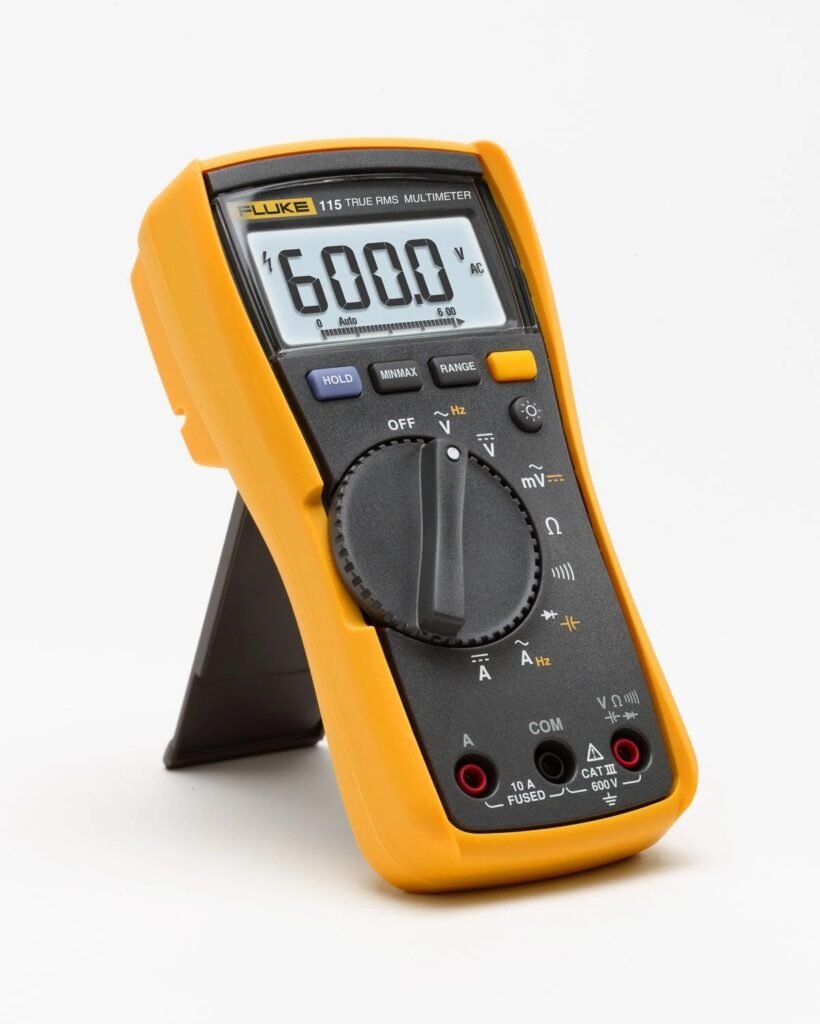
The Fluke 115 stands as a benchmark for accuracy and reliability in the professional and serious DIY circles. Renowned for its robust construction and precise readings, it’s an excellent choice for a wide spectrum of applications, from general electrical troubleshooting to detailed automotive diagnostics. Its performance on voltage measurements, particularly DC, makes it superb for assessing 12V, AGM, and Lithium battery health.
Key Features:
- True-RMS measurement capability.
- Auto-ranging for simplified operation.
- MIN/MAX/AVG recording for signal fluctuation tracking.
- Low impedance (LoZ) mode to eliminate ghost voltages.
- Large, backlit LCD display.
✅ Pros:
- Exceptional accuracy and reliability, especially for voltage and resistance tests (DC volts: ±0.5%).
- True-RMS ensures accurate readings with non-linear loads, crucial when dealing with complex charging systems.
- Durable construction with a solid build quality, able to withstand daily wear and tear in demanding environments.
- Compact, ergonomic design with a large, backlit LCD for easy one-handed operation and visibility in low light.
- Features auto-ranging, MIN/MAX/AVG recording to track signal fluctuations, and a low impedance (LoZ) mode to filter out ghost voltages, ensuring only real voltage is measured.
❌ Cons:
- Higher price point compared to many other multimeters, which can be a deterrent for casual users.
- Lacks dedicated milliamp/micro-amp ranges, limiting its use for fine electronics work or detecting very small parasitic drains.
- Display resolution and contrast can be slightly disappointing, appearing somewhat washed out at certain angles.
- Test leads can feel stiff and might be short for some bench setups, requiring aftermarket replacements for optimal flexibility.
Best for: Professionals and serious DIYers needing highly accurate and reliable voltage measurements for 12V, AGM, and Lithium batteries, as well as general electrical and automotive diagnostics. Its LoZ mode is particularly useful for avoiding ghost voltages when testing battery circuits or assessing complex charging systems.
Klein Tools MM420 Digital Multimeter
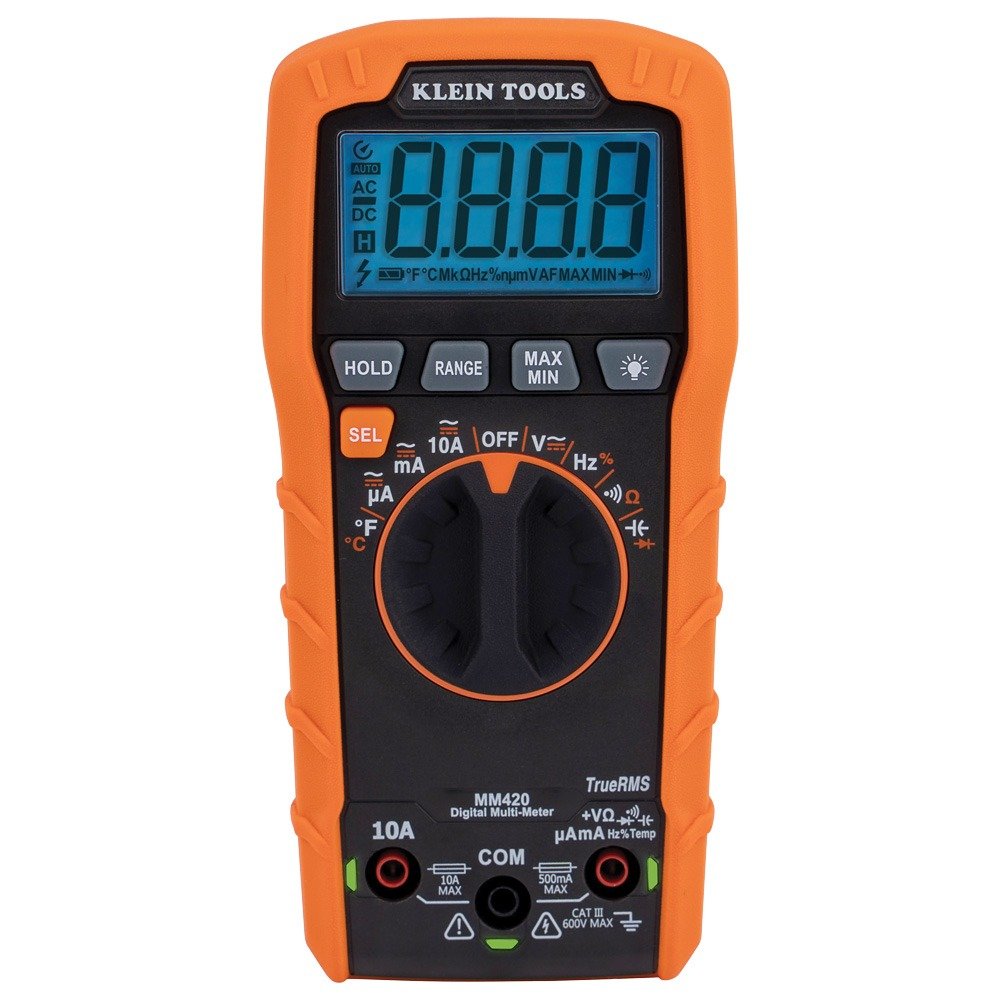
The Klein Tools MM420 is a sturdy and versatile auto-ranging digital multimeter, offering a compelling balance of features, durability, and affordability. Designed for residential, commercial, and light industrial applications, it’s a dependable tool for homeowners, apprentices, and DIY enthusiasts tackling everything from household wiring to automotive electrical issues, including 12V battery testing.
Key Features:
- Auto-ranging for user convenience.
- Measures AC/DC voltage (up to 600V) and current (up to 10A), resistance, capacitance, frequency, and temperature.
- Backlit LCD display.
- Durable casing.
✅ Pros:
- Auto-ranging for ease of use, automatically selecting the correct measurement range, reducing the chance of errors.
- Measures a wide range of functions including AC/DC voltage (up to 600V) and current (up to 10A), resistance, capacitance, frequency, and temperature, making it a highly versatile tool.
- Durable build quality that Klein Tools is known for, with a robust casing designed to withstand job site conditions.
- Features a backlit LCD display for good visibility in various lighting conditions, from bright workshops to dimly lit engine bays.
- Competitively priced for its feature set and robust build quality, offering excellent value.
❌ Cons:
- Does not feature True RMS measurements, which can affect accuracy on non-sinusoidal AC waveforms, though less critical for pure DC battery voltage.
- Limited capacitance range (up to 200µF) compared to some competitors, which might be a drawback for certain electronics tasks.
- The lower current circuit is incorporated with other test ranges, which isn’t ideal for all precise current measurements.
- Display is 4000 count, which is lower resolution than some premium meters, but generally sufficient for most applications.
Best for: Homeowners, apprentices, and DIY enthusiasts who need a versatile and durable multimeter for automotive electrical troubleshooting, including 12V battery voltage testing, and general household electrical tasks.
AstroAI Digital Multimeter and Analyzer TRMS 6000 Counts Volt Meter Ohmmeter Auto-Ranging Tester
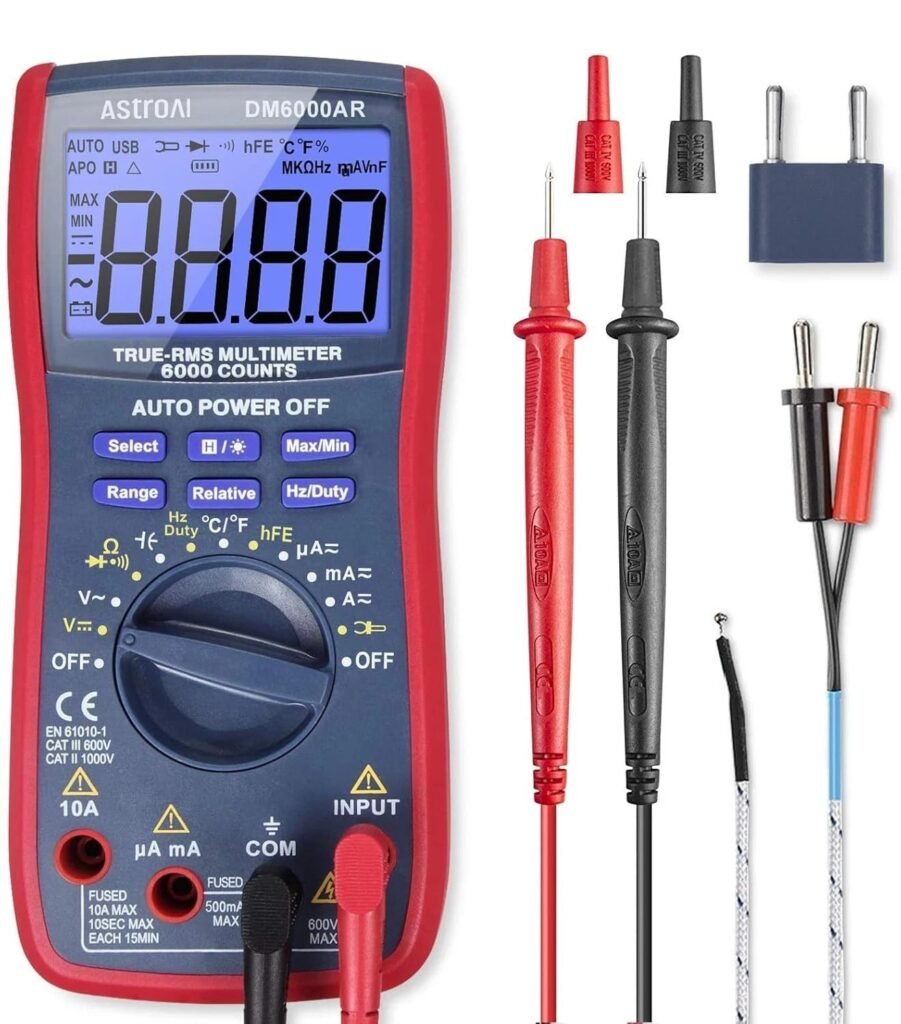
The AstroAI is an accessible entry-level, manual-ranging digital multimeter that provides essential functions at an extremely budget-friendly price. It’s often recommended for beginners, students, or anyone needing a straightforward tool for basic electrical measurements, especially common household and automotive battery checks.
Key Features:
- Manual ranging.
- Measures AC/DC voltage, DC current, and resistance.
- Dedicated 1.5V, 9V, and 12V battery test function.
- Backlit display and built-in flashlight.
✅ Pros:
- Extremely affordable, making it highly accessible for beginners, students, or as a convenient backup meter.
- Accurately measures AC/DC voltage, DC current, and resistance for basic troubleshooting tasks.
- Includes a dedicated 1.5V, 9V, and 12V battery test function, which is particularly useful for quick, general battery health checks.
- Compact and portable design, making it easy to fit in a toolbox, glove compartment, or even a pocket.
- Features a backlit display and a built-in flashlight, enhancing usability in dimly lit areas.
❌ Cons:
- Manual ranging requires the user to select the correct range, which can be less convenient and slower than auto-ranging, increasing the potential for user error.
- Not True-RMS, meaning it may not be as accurate for complex AC waveforms, though this is less critical for simple DC battery voltage.
- Lower safety rating (often CAT II) compared to professional-grade meters, making it less suitable for high-energy electrical systems.
- Some reviews indicate it struggles to accurately test higher voltages, impacting its versatility beyond basic tasks.
- Test leads are relatively short and can feel flimsy, potentially limiting flexibility and durability.
Best for: Beginners, hobbyists, and casual users who need a basic, affordable multimeter for testing 12V automotive batteries, household batteries (1.5V, 9V), and simple DIY electrical projects where advanced features aren’t required.
KAIWEETS Digital Multimeter TRMS 6000 Counts Voltmeter
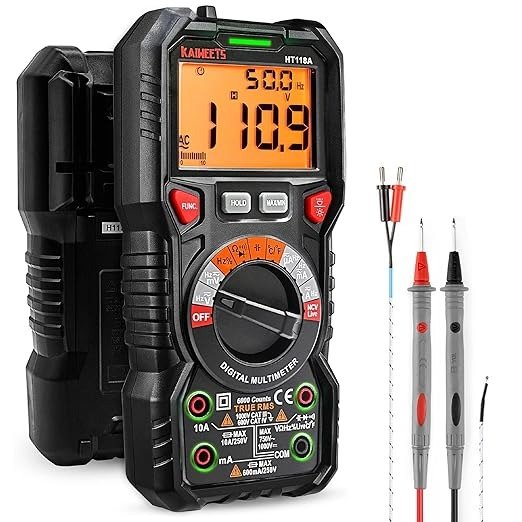
The Kaiweets stands out as a feature-rich and highly capable digital multimeter, particularly praised for its strong emphasis on safety and excellent performance given its modest price. It’s a solid choice for electronics hobbyists, DIYers, and general electrical work, offering robust and accurate voltage testing for various battery types.
Key Features:
- High safety ratings (CAT III 1000V and CAT IV 600V).
- True-RMS capability.
- Measures AC/DC voltage (up to 600V), current (up to 10A), resistance, capacitance, frequency, and temperature.
- Non-contact voltage (NCV) sensor and built-in flashlight.
- Protective rubber shell with test lead holders.
✅ Pros:
- High safety ratings (CAT III 1000V and CAT IV 600V), providing exceptional user protection for a meter in its price range.
- True-RMS capability for accurate AC measurements, even with non-linear loads, which is a premium feature at this price point.
- Measures a comprehensive range of functions, including AC/DC voltage (up to 600V), current (up to 10A), resistance, capacitance, frequency, and temperature.
- Features a convenient non-contact voltage (NCV) sensor for quick wire checks and a built-in flashlight for working in dark environments.
- Comes with a protective rubber shell that not only enhances durability but also cleverly serves as a test lead holder.
❌ Cons:
- Manual may not always be in English, potentially requiring users to download an English version, which can be an inconvenience.
- Some users report the display updates around 3 times/sec, which might be slower than high-end professional meters, though generally acceptable for most tasks.
- Build quality, while good for the price, might not be as rugged or feel as premium as top-tier brands like Fluke or Brymen.
Best for: Electronics hobbyists, DIYers, and electricians seeking a feature-rich, safe, and accurate multimeter for general electrical tasks, including reliable voltage testing of 12V, AGM, and Lithium batteries, without needing to invest in a premium price tag.
UNI-T UT210E Pro AC/DC Clamp Meter
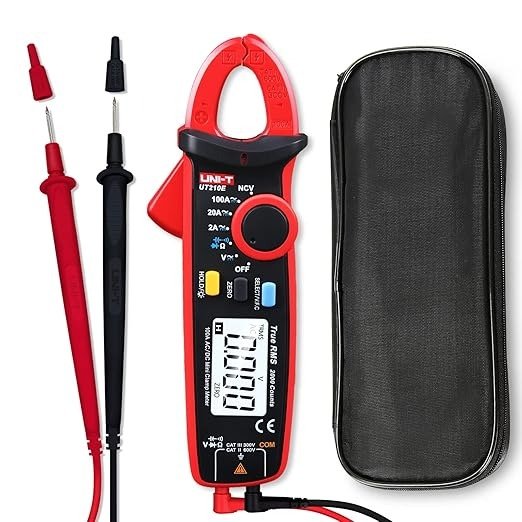
The UNI-T UT210E Pro is a compact and highly capable AC/DC clamp meter that doubles as a functional multimeter. Its standout feature is the ability to measure DC currents accurately via the clamp, a relatively rare and invaluable capability for automotive diagnostics (e.g., detecting parasitic battery drains) and certain electronics work, making it highly versatile for battery system analysis.
Key Features:
- Measures DC current with the clamp down to 1mA resolution.
- True-RMS for accurate AC voltage and current measurements.
- Compact and solid build with soft-touch overmoulds.
- Multimeter functions: voltage, resistance, continuity, and capacitance.
- Zero button for accurate relative measurements and backlight.
✅ Pros:
- Measures DC current with the clamp, offering high resolution down to 1mA, which is ideal for precise automotive diagnostics like tracking parasitic battery drain or analyzing charging systems.
- True-RMS for accurate AC voltage and current measurements, enhancing its utility for AC-related diagnostics in battery chargers or inverters.
- Compact and solid build with soft-touch overmoulds, making it comfortable and easy to handle in tight spaces.
- Offers a good range of multimeter functions, including voltage, resistance, continuity, and capacitance, providing comprehensive testing capabilities.
- Features a Zero button for accurate relative measurements and a backlight for improved visibility in various lighting conditions.
❌ Cons:
- As a clamp meter, while capable of voltage measurements through probes, its primary benefit is current measurement, meaning it might not be chosen solely for voltage.
- Some users have noted concerns about the plastic case’s durability compared to more rugged, dedicated multimeters from premium brands.
- Display count (often 2000 or 6000) might be lower than dedicated high-end multimeters, but typically sufficient for its intended use.
- The current rating of the probes (10A) is less relevant as its main current measurement strength comes from the clamp, though useful for small in-line measurements.
Best for: Automotive technicians, electronics hobbyists, and electricians who primarily need to measure DC and AC currents without breaking the circuit, especially for diagnosing battery drain or charging systems in 12V, AGM, and Lithium battery setups, while also having robust general multimeter capabilities.
Buying Guide: What to Consider When Purchasing a Multimeter for Battery Testing
Selecting the right multimeter involves more than just picking the cheapest or most expensive option. For accurate battery voltage testing, especially with diverse battery types like 12V lead-acid, AGM, and Lithium, several key factors come into play.
- Accuracy and Resolution:
- DC Voltage Accuracy: This is paramount. Look for a multimeter with a low percentage of error for DC voltage (e.g., ±0.5% or better). This ensures precise readings for battery state-of-charge, which can vary by tenths of a volt.
- Display Count: A higher display count (e.g., 6,000 counts vs. 2,000 counts) provides finer resolution. While 4,000 counts is often sufficient, higher counts allow you to see smaller voltage changes, which can be critical for precise battery diagnostics.
- True-RMS (Root Mean Square):
- While not strictly necessary for measuring pure DC battery voltage, True-RMS is vital if you’ll be troubleshooting charging systems, inverters, or other AC components related to your battery setup. Non-sinusoidal AC waveforms (common in modern electronics) can cause inaccurate readings on non-True-RMS meters. Having True-RMS indicates a higher-quality meter overall.
- Safety Ratings (CAT Ratings):
- Safety should never be compromised. Multimeters are rated by Categories (CAT I, II, III, IV) indicating their protection against transient voltage spikes.
- CAT II: For household outlets and portable devices.
- CAT III: For fixed installations like distribution panels, heavy appliances, and certainly most automotive and marine electrical systems. This is generally the minimum recommended for testing 12V batteries in vehicles or off-grid systems.
- CAT IV: For the origin of the installation, like utility service entrances.
- Always choose a meter with a CAT rating appropriate for the highest voltage and energy level you expect to encounter. For 12V systems, CAT III 600V is ideal.
- Safety should never be compromised. Multimeters are rated by Categories (CAT I, II, III, IV) indicating their protection against transient voltage spikes.
- Features for Battery Testing:
- Low Impedance (LoZ) Mode: Extremely useful for diagnosing battery circuits. This mode presents a low input impedance to the circuit, drawing enough current to discharge “ghost” or “phantom” voltages, ensuring you read only actual voltages, not induced ones. The Fluke 115 and Brymen BM235 are great examples of meters with this feature.
- Auto-Ranging vs. Manual Ranging: Auto-ranging meters automatically select the correct measurement range, making them easier and faster to use, especially for beginners. Manual-ranging meters require you to set the range, which can be more precise but slower and prone to error if the wrong range is selected.
- MIN/MAX/AVG: This feature allows the meter to record the minimum, maximum, and average readings over a period. This is invaluable for catching intermittent voltage drops or spikes that could indicate a problem with the battery or charging system.
- Current Measurement (Amps): While not for voltage testing, the ability to measure DC current (especially low currents like milliamps or micro-amps) is crucial for detecting parasitic drains on batteries, a common issue in automotive and RV applications. A clamp meter like the UNI-T UT210E Pro excels here.
- Backlight: Essential for working in dimly lit engine bays, under dashboards, or at night.
- Durability and Build Quality:
- A multimeter is a tool that will likely endure bumps and drops. Look for models with robust casings, rubberized armor, and high-quality test leads that are flexible and durable.
- Budget:
- Multimeters range from under $20 to several hundred dollars. Define your needs: are you a casual DIYer, a serious hobbyist, or a professional? There’s a sweet spot for every budget.
When checking your battery’s voltage, remember that different battery chemistries and states of charge will yield different readings. For instance, a fully charged 12V lead-acid battery should read around 12.6-12.8V, while a 12V lithium-ion (LiFePO4) battery might be 13.4-13.6V. Always consult a specific voltage chart for your battery type for accurate assessment.
You can find detailed charts for various battery types, including specific information on 12V battery voltage chart, 12V AGM golf cart battery voltage chart, and 12V lithium golf cart battery voltage chart. Recognizing the symptoms of low battery voltage can also guide your testing.
Frequenty Asked Questions On Best Multimeters for Accurate Battery Voltage Testing
Is True-RMS essential for DC battery voltage testing?
No, True-RMS is primarily for accurate measurements of AC (alternating current) waveforms, especially non-sinusoidal ones. For pure DC battery voltage measurements, a standard average-responding meter will typically be accurate enough.
However, a True-RMS meter often indicates a higher quality device overall and is crucial if you’re also troubleshooting AC components in your battery system, such as chargers or inverters.
What’s the difference between auto-ranging and manual-ranging multimeters?
An auto-ranging multimeter automatically detects the correct measurement range for the input it receives, simplifying operation and reducing the chance of user error.
A manual-ranging multimeter requires the user to select the appropriate range before taking a measurement. While auto-ranging is more convenient, some professionals prefer manual ranging for specific, precise applications.
How important are safety ratings (CAT levels) for battery testing?
A: Safety ratings (CAT I, II, III, IV) are very important. They indicate a multimeter’s ability to protect the user from transient voltage spikes. For testing 12V batteries in vehicles, boats, or off-grid systems, a meter with at least a CAT III 600V rating is highly recommended.
This ensures adequate protection against larger spikes that can occur in these environments compared to simple household electronics (CAT II). For more general information on electrical concepts, you can visit Voltage Basics.
Can a multimeter tell me the condition of my battery, or just its voltage?
A: A multimeter primarily measures voltage and, if equipped, current. While voltage gives you a good indication of a battery’s state of charge, it doesn’t tell you the battery’s overall “health” or its ability to deliver current under load (its capacity).
For a more comprehensive battery condition assessment, you would need a dedicated battery load tester or an internal resistance tester. However, a consistent drop in voltage under light load, or a voltage that quickly sags after charging, often points to a failing battery.
What is “ghost voltage” and why is LoZ mode useful for it?
A: Ghost voltage (also known as phantom voltage or stray voltage) is a phenomenon where a small, induced AC voltage reading appears on a disconnected or open circuit, even though there’s no actual power source. This occurs due to electromagnetic induction from nearby live wires.
A multimeter with a Low Impedance (LoZ) mode presents a low-resistance path, drawing enough current to dissipate these induced ghost voltages, allowing the meter to display only the true voltage present in the circuit. This is particularly useful in automotive or complex electrical systems where ghost voltages can lead to misdiagnosis.