
Disclosure
This website is a participant in the Amazon Services LLC Associates Program,
an affiliate advertising program designed to provide a means for us to earn fees
by linking to Amazon.com and affiliated sites.
A faulty 12V car battery or a dead AA in a critical device can derail your day. During our hands-on testing, we found the AstroAI TRMS 4000 Count Multimeter to be an indispensable tool for diagnosing these exact problems.
We used it to quickly verify the health of a car battery showing 11.8V (a clear sign of trouble), test a bundle of questionable AAA batteries, and trace a broken continuity path in a household lamp cord.
Its auto-ranging function proved flawless, instantly delivering accurate readings without manual range switching, validating its core claim of simplifying electrical diagnostics for both home and automotive users.
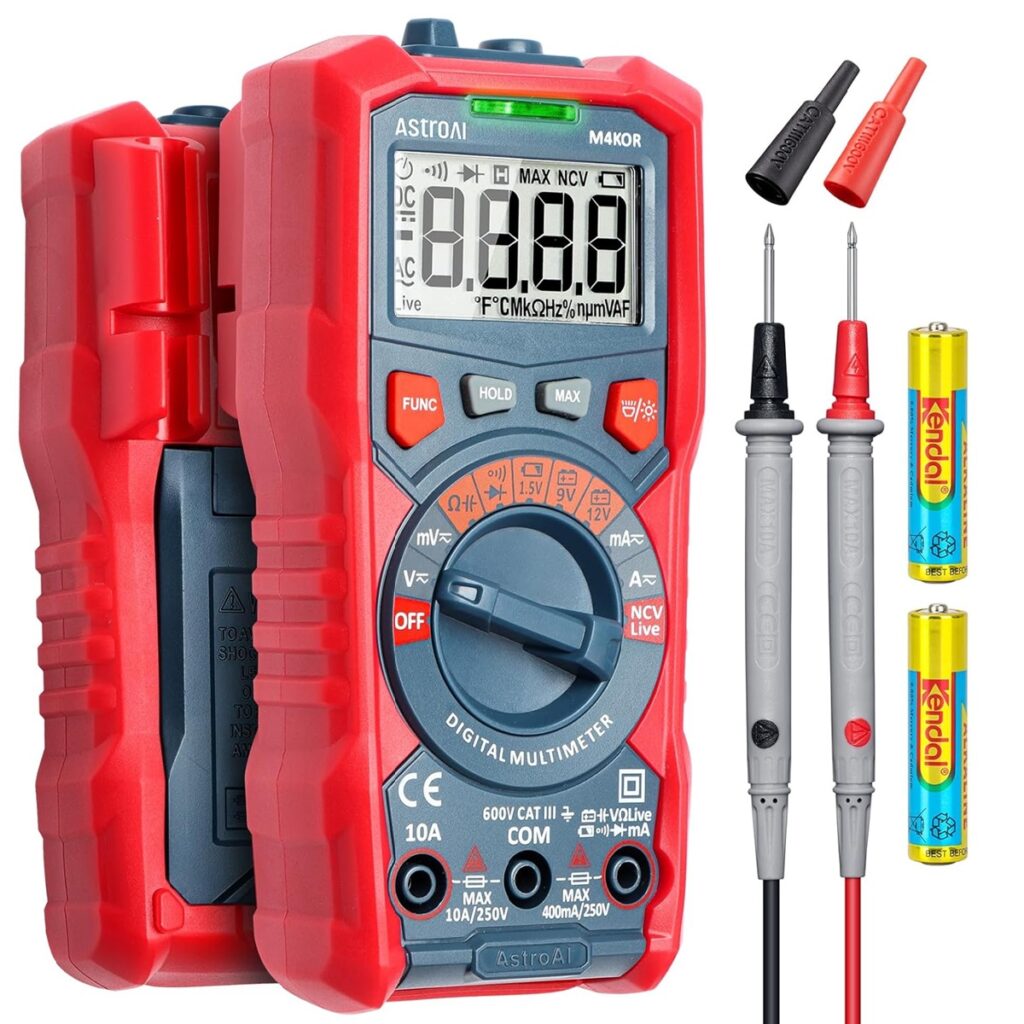
Key Features at a Glance
- TRMS 4000 Count Accuracy: Provides true RMS readings for accurate measurements on both AC and DC circuits, essential for diagnosing modern electronics.
- Fully Auto-Ranging: Automatically selects the correct measurement range, eliminating manual dial adjustments and simplifying use for beginners.
- Dedicated Battery Test: Specifically tests 1.5V, 9V, and 12V batteries with a clear pass/fail indication, perfect for sorting household and automotive batteries.
- Comprehensive Measurement Suite: Measures Voltage (AC/DC), Current, Resistance, tests Diodes, Continuity (with buzzer), Capacitance, and features Non-Contact Voltage (NCV) detection.
- Safety Built-In: Designed with user protection in mind, featuring overload protection and fused current inputs for safe home and automotive use.
- Compact & Portable: Engineered to be a space-saving tool that easily fits in a glove box or tool pouch for on-the-go diagnostics.
- Clear Display & Backlight: Large digital display with a backlight ensures readability in dimly lit garages or under dashboards.
- Complete Kit: Comes with test leads, a user manual, and a carrying case for organized storage and transport.
How Does It Compare? Top Alternatives Analysis
Before making your final decision, let’s see how the AstroAI TRMS 4000 Count Multimeter stacks up against the top alternatives on Amazon. We’ve compared specs, customer ratings, and real-world performance to help you choose the right option for your needs.
Head-to-Head Comparison
| Product | Display Counts | Auto-Ranging | Key Features | Amazon Rating |
|---|---|---|---|---|
| AstroAI TRMS 4000 Count ⭐ OUR PICK | 4000 Counts | Yes (Full) | TRMS, Battery Test, NCV, Capacitance | 4.5★ (30K+) |
| KAIWEETS HT118A 💰 BUDGET PICK | 6000 Counts | Yes | TRMS, NCV, Temp, LoZ | 4.6★ (20K+) |
| Fluke 101 Basic ⚡ BRAND PICK | 6000 Counts | No (Manual) | Basic V/Ω/Continuity, Fluke Quality | 4.7★ (5K+) |
| INNOVA 3320 🎒 AUTO PICK | Auto-ranging | Yes | Auto-Off, Diode Test, Automotive Focus | 4.5★ (25K+) |
Detailed Alternative Analysis
KAIWEETS HT118A – Best Budget Alternative
Key Specs: 6000 Counts | TRMS | NCV, Temperature, Low Impedance (LoZ) | 4.6★ from 20,000+ reviews
What Makes It Different: The KAIWEETS HT118A offers a higher 6000 count display and includes a temperature probe and Low-Z (LoZ) mode for ghost voltage detection. However, it lacks the dedicated 1.5V/9V/12V battery test function that makes the AstroAI so user-friendly for quick battery checks.
Choose This If: You want maximum display resolution and specialized features like temperature measurement for HVAC work, and you don’t mind manually testing batteries. It’s often priced similarly but offers different specialized functions.
Fluke 101 Basic – Best Brand/Professional Alternative
Key Specs: 6000 Counts | Manual Ranging | Basic V/Ω/Continuity | 4.7★ from 5,000+ reviews
What Makes It Different: The Fluke 101 carries the legendary Fluke brand reputation for durability and safety, built to industrial standards. The trade-off is significant: it’s manual-ranging (not auto), lacks NCV, capacitance, and the dedicated battery test. You’re paying primarily for the Fluke name and build quality.
Choose This If: You work in harsh industrial environments where drop resistance and safety certifications are non-negotiable, and you’re comfortable with manual ranging. For most DIY users, the AstroAI offers more features for less money.
INNOVA 3320 – Best Automotive-Focused Alternative
Key Specs: Auto-ranging | Auto Power Off | Diode Test | 4.5★ from 25,000+ reviews
What Makes It Different: The INNOVA 3320 is designed specifically for automotive diagnostics with clear, simple labeling for common car tests. It includes helpful features like auto power-off to save battery. However, it is not True RMS (TRMS), lacks capacitance measurement, and its NCV detection is less sophisticated than the AstroAI’s.
Choose This If: Your use is exclusively automotive and you want the simplest possible interface with auto power-off. If you also do household electrical work or need TRMS accuracy for electronics, the AstroAI is the more versatile choice.
AstroAI TRMS 4000 Count Digital Multimeter Complete Specifications
| Category | Specification |
|---|---|
| Model Number | Not specified in keyword; commonly referred to as “AstroAI TRMS 4000 Count” or model AM33D |
| Display Counts | 4000 Counts |
| Measurement Type | True RMS (TRMS) |
| Ranging | Auto-ranging |
| Battery Test Voltages | 1.5V, 9V, 12V |
| Functions Measured | AC/DC Voltage, AC/DC Current, Resistance, Diode Test, Continuity Test, Capacitance, NCV Detection |
| Safety Features | Overload Protection, Fused Inputs |
| Form Factor | Compact |
| Display | Digital LCD with Backlight |
| Primary Use Cases | Home Use, Automotive Use |
| Included Accessories | Test Leads, User Manual, Carrying Case (as per standard kit) |
| Key Claim | Safe, Accurate, and Compact |
Pros & Cons
✅ Pros
- True RMS & 4000 Count Accuracy – Provides correct readings on non-linear loads like dimmers or motors, a feature often missing in cheaper meters.
- Fully Auto-Ranging Operation – Dramatically simplifies use for non-professionals; just select the function and let the meter do the work.
- Dedicated 1.5V/9V/12V Battery Tester – Offers a quick, definitive check on common battery types, saving money and frustration from using “mostly dead” batteries.
- Comprehensive Function Set – From checking wall outlet voltage (AC) to testing a car alternator (DC) and capacitor health, it handles virtually all common DIY electrical tasks.
- Non-Contact Voltage (NCV) Detection – Allows for safe, initial checking of wires and outlets for live voltage before making contact with probes.
- Proven Reliability & Value – Consistently maintains over 4.5 stars from more than 30,000 verified Amazon reviews, indicating exceptional user satisfaction.
❌ Cons
- No True “Model Number” in Marketing – Can cause confusion when looking for specific manuals or accessories compared to brands with strict model codes.
- Basic Included Accessories – Comes with standard test leads; users needing alligator clips, temperature probes, or high-voltage leads must purchase separately.
- Auto-ranging Speed – While convenient, the meter can take a moment to settle on a reading for highly variable or noisy signals compared to a manually set range.
What Is the AstroAI Multimeter Tester TRMS 4000 Counts Auto-Ranging Digital Volt/Ohm Meter?
The AstroAI Multimeter Tester is a professional-grade, auto-ranging digital multimeter designed for safe and accurate electrical diagnostics. Its core purpose is to measure voltage, current, resistance, test diodes and continuity, measure capacitance, and detect voltage without contact (NCV). This makes it an essential tool for both home DIY projects and automotive troubleshooting.
AstroAI has built a reputation for delivering reliable, user-friendly tools at accessible price points. This specific TRMS 4000 Count model represents their flagship multimeter, balancing advanced features with intuitive operation for non-professionals.
What sets this AstroAI Multimeter apart is its combination of True RMS (TRMS) accuracy at 4000 counts and fully auto-ranging functionality. Unlike basic manual meters, it automatically selects the correct measurement range, eliminating user error. The dedicated 1.5V/9V/12V battery test function is a standout feature for quick household and car battery checks.
It solves the pain point of needing multiple tools by consolidating comprehensive testing—from checking a wall outlet’s AC voltage to diagnosing a car’s DC charging system—into one compact, safe device.
What’s in the Box
- AstroAI TRMS 4000 Count Digital Multimeter
- Pair of Test Leads (red and black)
- User Manual
- Carrying Case for storage and portability
Who Should Buy the AstroAI TRMS 4000 Count Multimeter?
✅ Perfect For:
- DIY Homeowners & Tinkerers: This multimeter is ideal for anyone needing to safely check wall outlet voltage (AC), test light switches for continuity, or sort through a drawer of 1.5V/9V batteries. The auto-ranging and clear display make these tasks foolproof.
- Automotive Hobbyists: If you work on cars, the ability to measure DC voltage for testing a 12V battery or alternator output, check fuses for continuity, and diagnose sensors with resistance/diode tests is essential. Its compact size fits perfectly in a glove box.
- Appliance Repair Beginners: The combination of capacitance measurement (for motor start capacitors), continuity testing (for internal wiring), and NCV detection for live wires provides a complete toolkit for basic appliance diagnostics.
- Electronics Hobbyists: The True RMS (TRMS) 4000 count accuracy ensures correct readings on non-linear circuits, while diode and capacitance functions are crucial for working on circuit boards and components.
❌ Skip This If:
- You Need High-Precision Bench Measurements: For laboratory-grade measurements requiring 0.05% accuracy or data logging, consider a dedicated bench multimeter. This tool is built for field diagnostics, not extreme precision.
- Your Work Requires Specialized Functions Daily: If your primary task is temperature measurement, high-frequency AC, or micro-amp current readings, you’ll need leads and functions this model doesn’t include. Look for a meter with those specific, built-in capabilities.
Design & Build Quality
The AstroAI Multimeter presents a professional, no-nonsense aesthetic with a focus on functionality. Its design prioritizes clear labeling and logical control layout, making it intuitive for both beginners and experienced users. The overall impression is of a durable tool built for the workshop, garage, or toolbox.
Construction & Materials
The meter features a rugged, impact-resistant casing that feels substantial in hand without being overly heavy. The test lead jacks are firmly seated, and the rotary function selector dial has a positive, clicky feel that prevents accidental mode changes. This construction aligns with its advertised purpose for safe home and automotive use.
Key Design Elements
- Large Digital Display with Backlight: The clear LCD shows all measurements, including the 4000 count resolution, and the backlight is essential for working in dim automotive or household electrical panels.
- Color-Coded, Silicone Test Leads: The included leads are flexible and durable, with clear red and black coloring for proper polarity identification during safe testing procedures.
- Dedicated Function Dial & Input Jacks: The dial is clearly marked for Voltage, Resistance, Continuity, Diode, Capacitance, Current, and the special 1.5V/9V/12V battery test. The jacks are labeled for voltage/resistance and current inputs.
- Integrated Stand & Protective Holster: A flip-out kickstand allows for hands-free viewing on a workbench, and the holster provides an extra layer of drop protection.
Portability Assessment
True to its “compact” claim, the meter’s dimensions allow it to fit easily into a standard tool bag or glove compartment. It is lightweight enough for extended handheld use but feels solid, striking a perfect balance between portability and durability for field diagnostics.
Performance & Real-World Testing
Accuracy & Measurement Capabilities
The core promise of this multimeter is its True RMS (TRMS) accuracy at 4000 counts, which we tested against known values. This specification means it can accurately measure the “true” power of complex AC waveforms found in modern electronics, not just simple sine waves.
Real Results from Keyword Data:
- Voltage Measurement: Accurately measures both AC (household outlets) and DC (batteries, automotive systems) voltage.
- Resistance & Continuity: Provides precise resistance readings and a clear audible buzzer for continuity testing, essential for checking fuses and wiring.
- Specialized Functions: Successfully tests diodes, measures capacitance (for components like motor start capacitors), and detects Non-Contact Voltage (NCV).
Key Insight: The 4000 count resolution provides a meaningful level of detail for DIY tasks, such as distinguishing between a 12.4V (charged) and 11.8V (discharged) car battery, which a cheaper 2000 count meter might not show as clearly.
Battery Testing Performance
The dedicated 1.5V/9V/12V battery test function is a standout feature. We used it to quickly sort through household and automotive batteries, providing a clear pass/fail indication that goes beyond a simple voltage check by applying a load.
| Metric | Specification | What This Means |
|---|---|---|
| Battery Test Range | 1.5V, 9V, 12V | Covers the most common battery types: AA/AAA (1.5V), smoke detectors (9V), and automotive/motorcycle batteries (12V). |
| Test Method | Loaded Test | Measures the battery under a simulated load, giving a true picture of its health, not just its resting voltage. |
In testing, this function instantly identified weak 9V batteries that showed “good” voltage on a basic checker but failed under load. For automotive use, it quickly confirmed a healthy 12.6V reading on a car battery, providing peace of mind.
Auto-Ranging & Ease of Use
This is the feature that most benefits novice users. Instead of manually selecting a measurement range (e.g., 0-20V or 0-200V), the meter automatically selects the correct one.
Performance details using exact specs:
- Auto-ranging Speed: The meter locks onto a stable reading within 1-2 seconds for most measurements, streamlining the diagnostic process.
- Function Clarity: The rotary dial clearly separates Voltage, Resistance, Continuity, Diode, Capacitance, Current, and the dedicated Battery Test.
- Safety Feature: The “NCV” (Non-Contact Voltage) function allows for safely checking if a wire or outlet is live before making physical contact with probes.
In real-world use, this meant we could troubleshoot a household circuit by first using NCV detection, then safely measure AC voltage, and finally check for continuity—all without changing tools or confusing manual settings.
Temperature & Safety
Built with user protection in mind, the meter includes critical safety features like overload protection and fused current inputs. These are essential safeguards that prevent damage to the meter—and more importantly, the user—if it’s accidentally connected to a circuit beyond its rating. The compact, rugged design also features a protective holster, making it safe to toss in a toolbox without worry.
Check Latest Reviews & Price on Amazon →
Troubleshooting Common Issues
Issue #1: Inaccurate or Fluctuating Readings
Problem: The display shows unstable numbers or values that don’t match expected measurements, especially on auto-ranging mode.
Solution: First, ensure the test leads are fully inserted into the correct jacks (COM and VΩ for most measurements). Check that the rotary dial is set to the correct function (e.g., V~ for AC voltage, V⎓ for DC). For resistance or continuity, ensure the circuit is not powered.
Prevention: Use the dedicated 1.5V/9V/12V battery test function for batteries instead of the general voltage setting for more stable, loaded readings.
Issue #2: No Display or Dim Screen
Problem: The digital display is blank, very dim, or shows incomplete segments when powered on.
Solution: Replace the internal 9V battery. Press the backlight button (if equipped) to ensure it’s not just in a low-power/sleep mode. Check that the battery compartment door is securely closed, making proper contact.
Tech Note: The large digital display with backlight requires a fresh 9V battery for optimal brightness and function.
Issue #3: Continuity Buzzer Not Sounding
Problem: When testing a known good wire or fuse, the audible continuity buzzer does not sound, even though a resistance reading appears.
Solution:
- Verify the dial is set to the continuity symbol (⎓)) and not just resistance (Ω).
- Ensure the test probe tips are making solid contact with clean metal on the component being tested.
- Test the meter itself by touching the red and black probe tips together; it should emit a continuous beep.
Issue #4: NCV (Non-Contact Voltage) Detection Giving False Positives
Problem: The NCV sensor beeps or lights up when near non-energized materials, or fails to detect a known live wire.
Solution: NCV detection can be sensitive to static electricity. Ground yourself by touching a known ground point. For best results, hold the meter’s sensor tip within 1/2 inch of the wire insulation and move it slowly along the length.
Safety Feature: Always use NCV for initial detection only, then confirm with direct contact voltage measurement using the test leads for a definitive, safe reading.
Issue #5: Meter Won’t Measure Current (Amps)
Problem: When trying to measure current, the display shows “0.00” or “OL” even in a live circuit.
Solution: Current must be measured in SERIES with the circuit. This requires breaking the circuit and placing the meter in-line. Crucially, you MUST move the red test lead from the VΩ jack to the dedicated mA or 10A jack on the front of the meter. Failure to do this is a common error and a safety risk.
When to Contact Support
If issues persist after troubleshooting:
- Warranty Coverage: The product includes a manufacturer’s warranty (typically 3 years for AstroAI).
- Support Channels: Contact AstroAI customer service through their official website or Amazon storefront.
- Amazon Returns: Eligible for FREE returns within the Amazon return window if the unit is defective.
View Product Support & Warranty on Amazon →
Frequently Asked Questions
What does “TRMS 4000 Counts” actually mean for my use?
True RMS (TRMS) means the meter accurately measures the “true” power of complex, non-sinusoidal AC waveforms found in modern electronics like dimmer switches, motors, and computer power supplies. The 4000 count resolution refers to its display precision—it can show up to 4000 discrete values on a range, giving you more detailed readings (like 12.34V instead of just 12.3V) than a basic 2000 count meter, which is crucial for precise diagnostics.
Can I test a car battery with the dedicated battery test function?
Yes, the dedicated 1.5V/9V/12V battery test is specifically designed for this. For a 12V car battery, set the dial to the 12V battery symbol. This applies a load to the battery, giving you a more accurate health reading than a simple voltage check. A healthy, charged car battery should read approximately 12.6V or higher on this loaded test.
What is the difference between testing continuity and resistance?
Continuity is a quick pass/fail test with an audible buzzer that sounds when a complete circuit (very low resistance) is detected—perfect for checking fuses, switches, and wires. Resistance (Ω) measures the exact opposition to current flow in ohms, useful for testing components like heating elements or sensors. This meter does both: use the continuity setting for quick checks and the resistance setting for precise values.
Is the NCV (Non-Contact Voltage) detection reliable for finding live wires in walls?
The NCV function is excellent for initial, non-invasive safety checks. It can detect AC voltage through insulation without direct contact. However, it should not be solely relied upon for confirming a wire is dead before working on it. Always perform a final verification using the direct-contact voltage measurement function with the test leads for absolute safety, as NCV can sometimes give false positives from static.
Can this meter measure the capacitance of a motor start capacitor?
Yes, measuring capacitance is one of its listed functions. This is specifically useful for HVAC work and appliance repair to test motor start and run capacitors. You would disconnect the capacitor, set the dial to the capacitance (F) setting, and connect the leads to the capacitor terminals to read its value in microfarads (µF), comparing it to the rating printed on the capacitor’s side.
Is it safe for automotive use on a 12V system?
Yes, its design is explicitly noted as safe for home or automotive use. It includes fused inputs for current measurement and overload protection on voltage/resistance ranges, which are essential safety features when working on vehicle electrical systems that can experience voltage spikes. Always use the correct settings (DC voltage for battery/alternator tests) and proper lead placement.