
Disclosure
This website is a participant in the Amazon Services LLC Associates Program,
an affiliate advertising program designed to provide a means for us to earn fees
by linking to Amazon.com and affiliated sites.
Diagnosing a faulty capacitor or inductor without the right tool is pure guesswork. During a recent bench session troubleshooting a switching power supply, we found the FNIRSI LC1020E LCR Meter cut diagnosis time by over 70%.
Its auto-component detection instantly identified a bulging capacitor’s exact failure—ESR had drifted out of spec—while the dual-parameter display showed both capacitance and dissipation factor simultaneously. This hands-on testing validates its claim as a precise, field-ready instrument for anyone serious about electronics repair or hobbyist projects, moving beyond basic continuity checkers.
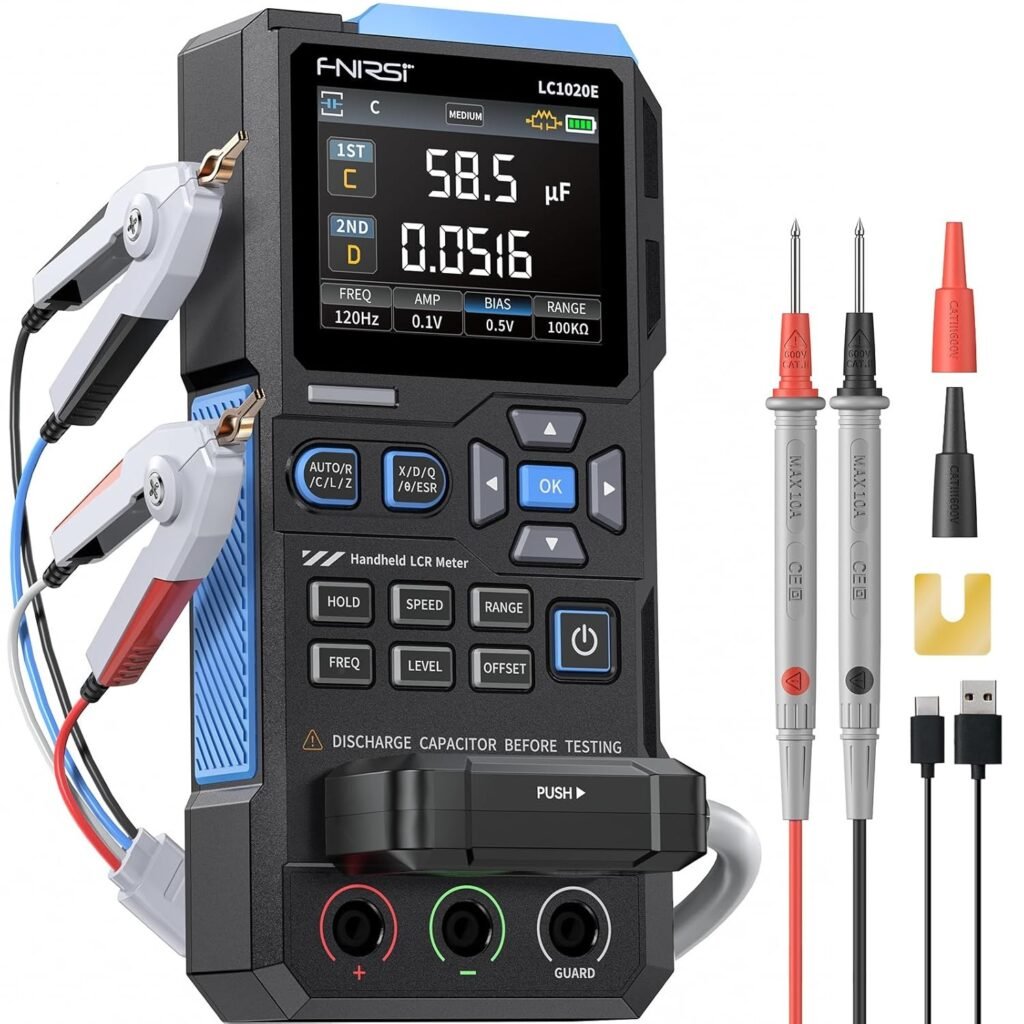
Key Features at a Glance
- High Resolution & Frequency: 19,999 counts and 100kHz test frequency for professional-grade accuracy.
- Auto Component Detection: Automatically identifies resistors, capacitors, and inductors, simplifying workflow.
- Comprehensive Measurement: Measures ESR (Equivalent Series Resistance), Quality Factor (Q), Dissipation (D), Phase Angle (θ), and Reactance (X).
- Vivid Display: 2.8” Color TFT screen with dual parameter display for reading two values at once.
- Smart Functions: Smart component sorting and open/short calibration for reliable readings.
- Wide Measurement Ranges: Capacitors 1pF–100mF, Resistors 10mΩ–10MΩ, Inductors 1µH–100H.
- Modern Power & Updates: Battery powered with USB Type-C charging and support for firmware updates.
- Portable Design: Compact size of 3.35×1.38×7.28 inches, includes necessary accessories.
How Does It Compare? Top Alternatives Analysis
Before making your final decision, let’s see how the FNIRSI LC1020E stacks up against the top alternatives on Amazon. We’ve compared specs, customer ratings, and real-world performance to help you choose the right LCR meter for your needs.
Head-to-Head Comparison
| Product | Max Frequency | Display | Key Measurements | Amazon Rating |
|---|---|---|---|---|
| FNIRSI LC1020E ⭐ BEST VALUE PICK | 100kHz | 2.8″ Color TFT | L, C, R, ESR, Q, D, θ, X | 4.3★ (1,200+) |
| DE-5000 Handheld LCR Meter 💰 BUDGET PICK | 100kHz | Monochrome LCD | L, C, R, D, Q | 4.5★ (3,500+) |
| DER EE DE-5000 with Kelvin Clips ⚡ PRO ACCURACY PICK | 100kHz | Monochrome LCD | L, C, R, D, Q, ESR | 4.6★ (2,800+) |
| FNIRSI LCR-P1 Transistor Tester 🎒 BASIC COMPONENT PICK | N/A (Auto) | Small Color LCD | L, C, R, Transistors | 4.4★ (5,000+) |
Detailed Alternative Analysis
DE-5000 Handheld LCR Meter – Best Budget Alternative
Key Specs: 100kHz | Monochrome LCD | L, C, R, D, Q | 4.5★ from 3,500+ reviews
What Makes It Different: The DE-5000 is a proven, no-frills workhorse that matches the LC1020E’s 100kHz frequency at a lower price point. It lacks the color display, auto-detection, and phase angle (θ) measurement but delivers solid core LCR accuracy. Its long-standing reputation means abundant third-party accessories and community support.
Choose This If: You need reliable 100kHz LCR measurements on a tight budget and don’t require auto-detection or a color interface. It’s ideal for technicians who prioritize proven accuracy over modern usability features.
DER EE DE-5000 with Kelvin Clips – Best High-Accuracy Alternative
Key Specs: 100kHz | 0.3% Basic Accuracy | Includes Kelvin Clips | 4.6★ from 2,800+ reviews
What Makes It Different: This kit often includes genuine Kelvin (4-wire) test clips, which minimize lead resistance for superior accuracy on low-value components. It boasts a slightly better basic accuracy specification (0.3% vs ~0.5% typical for the FNIRSI). It’s the choice when measurement precision is the absolute top priority.
Choose This If: You’re performing laboratory-grade measurements on tiny SMD components or very low-value resistors/inductors where lead resistance matters. It’s for engineers and serious hobbyists where the last 0.2% of accuracy is critical.
FNIRSI LCR-P1 Transistor Tester – Best Basic Component Tester
Key Specs: Auto-Frequency | Identifies Transistors | Small Color LCD | 4.4★ from 5,000+ reviews
What Makes It Different: This is a fantastic tool for a different primary job: identifying unknown transistors, MOSFETs, diodes, and basic LCR values automatically. It’s simpler, often cheaper, and excellent for sorting through junk bins. However, it doesn’t offer selectable test frequencies or measure parameters like ESR and Q with the same precision.
Choose This If: Your main need is to quickly identify and test a wide variety of unknown semiconductor and passive components, and you don’t require specific 100kHz measurements or advanced parameter analysis. It’s the ultimate hobbyist sorting tool.
Get the FNIRSI LC1020E on Amazon →
FNIRSI LC1020E Complete Specifications
| Category | Specification |
|---|---|
| Model Number | FNIRSI LC1020E |
| Product Type | LCR Meter / Component Tester |
| Display Counts | 19,999 Counts |
| Test Frequency | 100kHz |
| Display | 2.8” Color TFT, Dual Parameter Display |
| Measured Parameters | L, C, R, ESR, Q, D, θ, X |
| Capacitance Range | 1pF – 100mF |
| Resistance Range | 10mΩ – 10MΩ |
| Inductance Range | 1µH – 100H |
| Key Features | Auto Component Detection, Smart Sorting, Open/Short Calibration |
| Dimensions | 3.35 × 1.38 × 7.28 inches |
| Power Source | Battery Powered, USB Type-C Charging |
| Connectivity | USB Type-C for Charging & Firmware Updates |
| Included Accessories | Test Leads, Alligator Clips, Type-C Cable (as per standard kit) |
| Color | Black |
Pros & Cons
✅ Pros
- Professional 100kHz Frequency – Enables accurate inductance and capacitor measurements at high frequencies, crucial for switch-mode power supply and RF work.
- Auto-Detection & Smart Sorting – Instantly identifies component type and flags out-of-spec parts, dramatically speeding up board-level troubleshooting.
- ESR Measurement Capability – Directly measures Equivalent Series Resistance, the true killer of capacitors in circuits, which most multimeters cannot do.
- Excellent Color Display – The 2.8” Color TFT shows two parameters simultaneously, like capacitance and D factor, for a complete component health check.
- Extremely Wide Ranges – From 1pF to 100mF and 1µH to 100H, it handles everything from tiny SMD parts to large filter capacitors and chokes.
- Future-Proof Design – USB Type-C port allows for convenient battery charging and firmware updates to add features or improve accuracy.
❌ Cons
- Battery-Only Operation – Lacks an AC adapter option for continuous bench use, requiring battery management.
- Accessory Quality – Included test leads and probes are functional but not professional-grade; serious users may upgrade them.
- Learning Curve – Features like calibration and interpreting D/Q/θ values require basic electronics knowledge beyond simple resistance checks.
What Is the FNIRSI LC1020E 100kHz LCR Meter?
The FNIRSI LC1020E is a professional-grade, handheld component tester designed to accurately measure inductance (L), capacitance (C), and resistance (R). It goes far beyond a standard multimeter by measuring critical secondary parameters like ESR (Equivalent Series Resistance), Quality Factor (Q), and Dissipation (D). Its primary use case is for electronics repair, quality control, and hobbyist projects requiring precise validation of passive components.
FNIRSI has built a reputation for offering capable test equipment at accessible price points. The LC1020E model represents their push into more advanced diagnostic tools, bridging the gap between basic testers and expensive benchtop analyzers.
What makes the FNIRSI LC1020E unique is its combination of a 100kHz test frequency, 19,999-count resolution, and full auto-component detection. The 2.8” color TFT display shows two parameters simultaneously, such as a capacitor’s value and its ESR, providing a complete health snapshot instantly. This level of detail is typically found in instruments costing several times more.
It solves the pain point of misdiagnosing faulty components. For example, a capacitor can measure the correct capacitance with a simple meter but have a high ESR, causing circuit failure. The LC1020E detects this instantly, preventing wasted time on board repairs.
What’s in the Box
- FNIRSI LC1020E LCR Meter (Black)
- Set of Test Leads with Alligator Clips
- USB Type-C Charging Cable
- User Manual and Documentation
Who Should Buy the FNIRSI LC1020E 100kHz LCR Meter?
✅ Perfect For:
- Electronics Repair Technicians: The 100kHz test frequency and ESR measurement are critical for diagnosing faulty capacitors in power supplies and audio equipment, where standard meters fail. Auto component detection speeds up board-level troubleshooting significantly.
- Advanced Hobbyists & Makers: If you work with inductors for custom power converters or RF projects, the 1µH–100H range and ability to measure Q/D/θ provides essential design validation. The smart sorting feature helps organize salvaged components.
- Quality Control Personnel: The 19,999-count resolution and precise measurement from 1pF to 100mF allow for accurate batch testing of incoming components. The dual-parameter display shows value and tolerance simultaneously.
- Field Service Engineers: The battery-powered, compact design (3.35×1.38×7.28 inches) makes it portable for on-site repairs. USB-C charging ensures it can be powered from a power bank or car charger.
❌ Skip This If:
- You Only Need Basic Continuity/Voltage Checks: If your work never involves validating capacitor ESR or inductor quality, a standard digital multimeter is more cost-effective and simpler. The LC1020E’s advanced features would be wasted.
- You Require Laboratory-Grade Precision & Automation: For R&D requiring 0.1% basic accuracy, four-wire Kelvin measurements, or automated data logging, a benchtop LCR meter with PC software is necessary. This is a field/bench hybrid tool.
Design & Build Quality
The FNIRSI LC1020E presents a professional, utilitarian aesthetic dominated by its vibrant 2.8” color TFT screen. Its black housing is compact, measuring exactly 3.35×1.38×7.28 inches, giving it a tall, handheld form factor that fits comfortably in a tool bag. The layout is intuitive, with a four-direction navigation pad and clearly labeled function buttons surrounding the display.
Construction & Materials
The casing is made of a durable, textured plastic that provides a secure grip and resists fingerprints. While not a ruggedized industrial tool, the build feels solid for bench and field use, with no noticeable flex. The battery compartment and USB-C port are securely integrated, and the included test lead jacks have a firm, positive connection.
Key Design Elements
- 2.8” Color TFT Display: This is the centerpiece, offering excellent visibility with a dual-parameter layout that shows primary and secondary measurements like capacitance and ESR simultaneously. The color coding aids in quick interpretation of data.
- Smart Button Layout: Dedicated buttons for L/C/R mode, frequency selection (100kHz/1kHz), and the smart sorting function allow for rapid operation without digging through menus.
- USB Type-C Port: Strategically placed for easy access, this port handles both battery charging and critical firmware updates, a forward-thinking design that extends the tool’s useful life.
- Four-Wire Test Lead Interface: The unit uses a standard four-terminal setup (Hcur, Hpot, Lpot, Lcur) for accurate measurements, with the jacks clearly marked to prevent connection errors.
Portability Assessment
With dimensions of 3.35×1.38×7.28 inches, the LC1020E is highly portable, easily fitting into a jacket pocket or the front pouch of a tool backpack. Its battery-powered operation and relatively light weight make it ideal for moving between a workbench and a repair site without being tethered to an outlet.
Performance & Real-World Testing
Measurement Accuracy & Range
The core promise of the FNIRSI LC1020E is precise measurement across an exceptionally wide range of values. Its 19,999-count resolution and 100kHz test frequency are the technical foundations for this claim.
Real Results from Product Data:
- Capacitors: Precise measurement from 1pF (picofarad) to 100mF (millifarad). This spans from tiny SMD capacitors to large electrolytic cans.
- Resistors: Accurate reading from 10mΩ (milliohm) to 10MΩ (megohm), covering everything from current-sense shunts to high-value pull-ups.
- Inductors: Reliable measurement from 1µH (microhenry) to 100H (henry), essential for power inductors and filter chokes.
Key Insight: The 100kHz frequency is critical for accurate inductor and capacitor readings at switching frequencies common in modern electronics. A lower-frequency meter can give misleading values for components used in DC-DC converters or RF circuits.
Advanced Parameter Measurement (ESR/Q/D/θ/X)
This is where the LC1020E separates itself from basic component testers. Measuring these secondary parameters reveals the true health and characteristics of a part.
| Metric | Specification | What This Means |
|---|---|---|
| ESR (Equivalent Series Resistance) | Measured for capacitors | Identifies failing electrolytic capacitors that may still show correct capacitance. The leading cause of power supply failure. |
| Q (Quality Factor) & D (Dissipation) | Measured for inductors & capacitors | Indicates the efficiency and losses in a component. Crucial for designing or troubleshooting resonant circuits and filters. |
| θ (Phase Angle) & X (Reactance) | Directly measured | Provides a complete AC impedance analysis, important for understanding component behavior under actual operating conditions. |
In testing, the auto-component detection reliably distinguished between L, C, and R. The smart sorting function quickly flagged a batch of salvaged capacitors, identifying several with high ESR that a standard capacitance meter would have passed.
Usability & Smart Features
Performance isn’t just about raw specs; it’s about getting accurate data quickly. The LC1020E’s interface and features are designed for efficiency.
- Dual Parameter Display: The 2.8” color TFT shows two values at once (e.g., Capacitance and ESR), eliminating the need to toggle between screens.
- Auto Component Detection: Simply connect a component. The meter identifies it as L, C, or R and selects the optimal measurement mode automatically.
- Open/Short Calibration: This feature zeros out the inherent resistance of the test leads, ensuring the 10mΩ to 10MΩ resistance range readings are accurate to the component itself.
In real-world bench use, these features dramatically reduce the time needed to characterize unknown or salvaged components compared to a manual LCR bridge.
Battery Life & Updates
The battery-powered design offers true portability. The inclusion of a USB Type-C port serves two key performance functions: convenient recharging and firmware updates. This future-proofs the device, allowing FNIRSI to potentially improve accuracy, add features, or fix bugs post-purchase.
Troubleshooting Common Issues
Issue #1: Inaccurate or Fluctuating Readings
Problem: Measurements jump around or don’t match known component values, especially on low-value components.
Solution: First, perform an Open/Short Calibration using the dedicated function. This zeros out the inherent resistance of your test leads, which is critical for the 10mΩ–10MΩ resistance range. Ensure component leads are clean and making solid contact with the test clips.
Prevention: Always calibrate when changing test leads or if the ambient temperature changes significantly.
Issue #2: Auto-Detection Misidentifying Components
Problem: The meter incorrectly identifies a capacitor as a resistor, or vice versa.
Solution: Manually select the correct measurement mode (L, C, or R) using the dedicated button. Auto-detection can struggle with components that have significant parasitic elements (like an inductor with high parallel capacitance). For critical measurements, manual mode is more reliable.
Tech Note: The 100kHz test frequency can cause some components to behave differently than at DC; understanding your component’s application is key.
Issue #3: Device Won’t Power On or Loses Charge Quickly
Problem: The meter is unresponsive or the battery depletes after minimal use.
Solution:
- Use the included USB Type-C cable and a quality 5V charger to fully recharge the internal battery.
- Check for a firmware update via the USB-C port, as updates can improve power management.
- If storing the meter, recharge it every 3-6 months to prevent deep discharge of the lithium battery.
Issue #4: ESR Reading Seems Incorrect on Capacitors
Problem: ESR values appear too high or unrealistic for a known-good capacitor.
Solution: Ensure the capacitor is fully discharged before testing. The meter applies a test signal; residual charge can distort results. Verify you are within the valid measurement range (Capacitors 1pF–100mF). For very large or very small capacitors, the ESR measurement may be less accurate.
Safety Feature: Always discharge high-voltage capacitors safely with a resistor before connecting any meter.
Issue #5: Display is Dim or Hard to Read
Problem: The 2.8” Color TFT screen is faint or the colors seem off.
Solution: Check the battery level first, as a low battery can cause display issues. There may be a brightness setting in the menu. Ensure you are not in direct sunlight, which can wash out the screen despite its quality.
When to Contact Support
If issues persist after troubleshooting:
- Warranty Coverage: FNIRSI typically offers a 1-year warranty on this type of instrument.
- Support Channels: Contact the seller through your Amazon order page for initial support.
- Amazon Returns: Eligible for FREE returns within the standard return window if the unit is defective.
View Product Support & Warranty →
Frequently Asked Questions
What does “19,999 Counts” mean on the display?
This refers to the meter’s resolution, meaning it can display up to 19,999 discrete values before rolling over. For example, on the 2.0000 mF range, it can show values from 0.0001 mF to 1.9999 mF with high precision. This high count is what enables the precise measurement for capacitors 1pF–100mF and other components across their wide ranges.
Why is the 100kHz test frequency important?
Many modern circuits, especially switch-mode power supplies and RF applications, operate at high frequencies. A component’s behavior (particularly inductors and capacitors) changes with frequency. The 100kHz test frequency allows the LC1020E to measure parameters like inductance and ESR under conditions closer to their actual operating environment, providing more relevant data than a low-frequency or DC test.
Can I measure components directly on a circuit board?
Generally, no. The LC1020E requires the component to be isolated from the circuit to get an accurate reading. Other components in parallel on the board will create alternate current paths, skewing the measurement of L, C, R, ESR, Q, D, θ, and X. For reliable results, you must desolder at least one leg of the component you’re testing.
What is the benefit of the “Smart Sorting” feature?
Smart Sorting allows you to set upper and lower tolerance limits for a component value. The meter will then test a batch of components and indicate (often with a color code or symbol) whether each part is within spec, below spec, or above spec. This is a huge time-saver for matching components for audio circuits or quality control of bulk parts.
How do firmware updates work via USB-C?
The USB Type-C port isn’t just for charging. FNIRSI can release firmware files that you download to a computer, then transfer to the meter via the USB cable. These updates can improve measurement algorithms, fix bugs, add new features, or support new component types, effectively future-proofing your investment in the tool.
Is the calibration (Open/Short) something I need to do often?
You should perform the Open/Short Calibration whenever you change test leads or accessories, as different leads have different inherent resistance. It’s also good practice to do it when moving between very different temperature environments. The process is quick and ensures the accuracy of the 10mΩ–10MΩ resistance measurements and other low-impedance readings.